
Produit scalaire – 2nde S
I. Définition
Soit \overrightarrow{u} et \overrightarrow{v} deux vecteurs; on appelle produit scalaire de \overrightarrow{u} par \overrightarrow{v} le nombre réel noté \overrightarrow{u}.\overrightarrow{v} défini par :
\cdot ~~ \overrightarrow{u}.\overrightarrow{v} = ||\overrightarrow{u}|| × ||\overrightarrow{v}|| \times \cos( \widehat{\overrightarrow{u} ~;~\overrightarrow{v}} ) si \overrightarrow{u} \ne 0 et \overrightarrow{v} \ne 0
\cdot ~~ \overrightarrow{u}.\overrightarrow{v} = 0 si \overrightarrow{u} = \overrightarrow{0} ou \overrightarrow{v} = \overrightarrow{0}
\overrightarrow{u}.\overrightarrow{v} se lit « \overrightarrow{u} 𝑠𝑐𝑎𝑙𝑎𝑖𝑟𝑒 \overrightarrow{v} »
Exemples
\overrightarrow{u} et \overrightarrow{v} sont deux vecteurs, déterminer \overrightarrow{u}.\overrightarrow{v}
a) ||\overrightarrow{u}|| = 2\sqrt{3} ~;~ ||\overrightarrow{v}|| = 4 et \cos (\widehat{\overrightarrow{u} ~;~\overrightarrow{v}}) = \dfrac{\sqrt 3}{2}
a) ||\overrightarrow{u}|| = 2\sqrt{3} ~;~ ||\overrightarrow{v}|| = 4 et \text{mes} (\widehat{\overrightarrow{u} ~;~\overrightarrow{v}}) = \dfrac{\pi}{2}
Remarque
Pour trois points A, B et C distincts \overrightarrow{AB}.\overrightarrow{AC}= AB \times AC \times \cos(\widehat{BAC})
II. Propriétés
Pour tous vecteurs \overrightarrow{u} et \overrightarrow{v}, on a :
1- \overrightarrow{u}.\overrightarrow{v} = \overrightarrow{v}.\overrightarrow{u}
2- |\overrightarrow{u}.\overrightarrow{v}| \leq || \overrightarrow{u} || \times || \overrightarrow{v} ||
3- \overrightarrow{u} et \overrightarrow{v} sont colinéaires et :
– de même sens si et seulement si \overrightarrow{u}.\overrightarrow{v} = ||\overrightarrow{u}|| \times ||\overrightarrow{v}||
– de sens contraire si et seulement si \overrightarrow{u}.\overrightarrow{v} = - ||\overrightarrow{u}|| \times ||\overrightarrow{v}||
III. Carré scalaire
a) Définition
Le carré scalaire d’un vecteur \overrightarrow{u} est défini par \overrightarrow{u}.\overrightarrow{u}. on le note \overrightarrow{u}^2
b) Propriété
Pour tout vecteur \overrightarrow{u} on a : \overrightarrow{u}^2 = ||\overrightarrow{u}||^2
Exemple
On donne \overrightarrow{u} avec ||\overrightarrow{u}|| = \sqrt{5}. Calcule \overrightarrow{u}^2
Remarque : pour tous points distincts A et B, on a : \overrightarrow{AB}^2 = ||\overrightarrow{AB}||^2 = AB^2
c) Autre expression du produit scalaire
Propriété 1
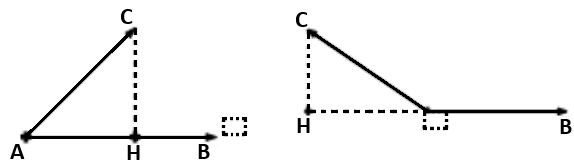
Pour tous points A, B et C tels que A ≠ B
On a \overrightarrow{AB}.\overrightarrow{AC} = \overrightarrow{AB} \times \overrightarrow{AH} où H est le projeté orthogonal de C sur la droite (AB)
Exemple
ABCD est un carré de coté 4cm. Calcule \overrightarrow{AB}.\overrightarrow{AC} et \overrightarrow{AB}.\overrightarrow{AD}
Propriété 2
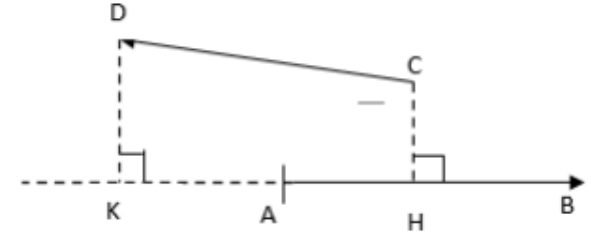
Soit A, B, C et D quatre points tels que A ≠ B
\overrightarrow{AB}.\overrightarrow{CD} = \overline{AB} \times \overline{HK} où H et K sont les projetés orthogonaux respectifs des points C et D sur la droite (AB)
IV. Propriétés du produit scalaire
1. Vecteurs orthogonaux
a. Propriété
Pour tous vecteurs \overrightarrow{u} et \overrightarrow{v} on a :
\overrightarrow{u} et \overrightarrow{v} sont orthogonaux si et seulement si \overrightarrow{u}.\overrightarrow{v} = 0
b- Conséquence
– Soit (D) et (D’) deux droites de vecteurs directeurs respectifs \overrightarrow{u} et \overrightarrow{v} on a :
(D) ⏊ (D’) ⟺ \overrightarrow{u}.\overrightarrow{v}=0
– Soit les points A, B, C, et D avec A \ne B et C \ne D
On a (AB) ⏊ (CD) ⟺ \overrightarrow{AB} et \overrightarrow{CD} = 0
– Soit les points A, B et M avec A \ne B
M appartient au cercle (𝜑)de diamètre [𝐴𝐵] si et seulement si \overrightarrow{MA}.\overrightarrow{MB} = 0
Exemple
ABCD est un carré. Calcule le produit scalaire \overrightarrow{AC}.\overrightarrow{DB}
2. Opération sur les produits scalaires
Propriétés
Pour tous vecteurs \overrightarrow{u}, \overrightarrow{v}, \overrightarrow{t}, \overrightarrow{w} du plan et pour tout nombre réel k on a :
\overrightarrow{u} . (\overrightarrow{v} + \overrightarrow{w} ) = \overrightarrow{u} . \overrightarrow{v} + \overrightarrow{u} . \overrightarrow{w}
(k.\overrightarrow{u} ) \overrightarrow{v} = \overrightarrow{u} (k. \overrightarrow{v} ) = k(\overrightarrow{u} . \overrightarrow{v} )
(\overrightarrow{u} + \overrightarrow{w} ). \overrightarrow{v} = \overrightarrow{u} . \overrightarrow{v} + \overrightarrow{w} . \overrightarrow{v}
(\overrightarrow{u} + \overrightarrow{v} ).( \overrightarrow{w} + \overrightarrow{t} )= \overrightarrow{u} . \overrightarrow{w} + \overrightarrow{u} . \overrightarrow{t} + \overrightarrow{v} . \overrightarrow{w} + \overrightarrow{v} . \overrightarrow{t}
(\overrightarrow{u} + \overrightarrow{v} )^2 = \overrightarrow{u}^2 + 2\overrightarrow{u} .\overrightarrow{v} + \overrightarrow{v}^2
(\overrightarrow{u} − \overrightarrow{v} )^2 =\overrightarrow{u}^2 − 2\overrightarrow{u} .\overrightarrow{v} + \overrightarrow{v}^2
(\overrightarrow{u} − \overrightarrow{v} ).( \overrightarrow{u} + \overrightarrow{v} ) = \overrightarrow{u}^2 − \overrightarrow{v}^2
3. Produit scalaire et norme
Propriété
Pour tous vecteurs \overrightarrow{u} et \overrightarrow{v} ,
\overrightarrow{u}.\overrightarrow{v} = \dfrac{1}{2} (||\overrightarrow{u} + \overrightarrow{v}||^2 − ||\overrightarrow{u}||^2 − ||\overrightarrow{v}||^2)
IV. Relation métrique dans un triangle
1. Produit scalaire dans un triangle
Propriété
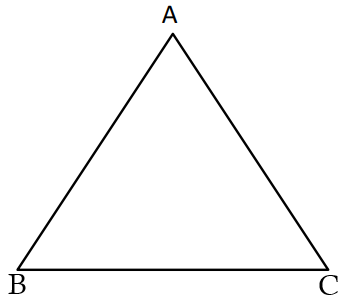
Soit A, B et C trois points non alignés. On a : \overrightarrow{AB}.\overrightarrow{AC} = \dfrac{1}{2} (AC^2 + AB^2 - BC^2)
Remarque
\overrightarrow{BA}.\overrightarrow{BC} = \dfrac{1}{2} (BC^2 + BA^2 - AC^2)
\overrightarrow{CA}.\overrightarrow{CB} = \dfrac{1}{2} (CA^2 + CB^2 - AB^2)
Exemple
Soit ABC un triangle tels que AB = 5 ; AC = 6 et BC = 3
Calcule \overrightarrow{AB}.\overrightarrow{AC}
2. Théorème d’Al Kashi
Propriété
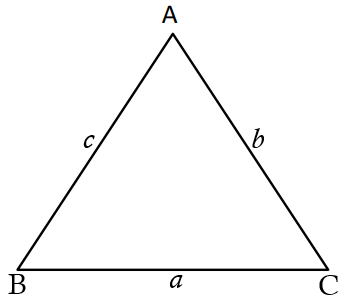
Soit ABC un triangle quelconque.
Posons BC = a, AC = b, AB = c
Puis \widehat{A} = \widehat{BAC} ~;~ \widehat{B}=\widehat{ABC} ~;~ \widehat{C}=\widehat{ACB}
On a :
a^2 = b^2 + c^2 - 2bc . \cos \widehat{A}
b^2 = a^2 + c^2 - 2ac . \cos \widehat{B}
c^2 = a^2 + b^2 - 2ab . \cos \widehat{C}
Exemple :
ABC est un triangle tels que AB = 8 ; AC = 3 et \text{mes} \widehat{BAC} = \dfrac{\pi}{3}
Calcule BC
3. Caractéristique d’un triangle rectangle
Propriété
Soit ABC triangle, H pied de la hauteur issue de A. Les affirmations suivantes sont équivalentes.
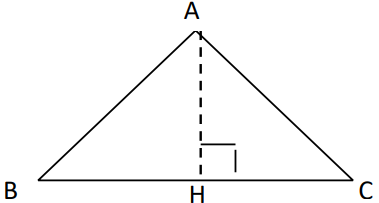
- ABC est un triangle rectangle en A
- BC^2 = AB^2 + AC^2
- BA^2 = \overline{BH} \times \overline{BC}
- HA^2 = \overline{HB} \times \overline{HC}
VI. Produit scalaire de vecteurs connaissant leurs coordonnées
1. Expression du produit scalaire dans une base orthonormée
Propriété :
Soit (𝑖 , 𝑗 ) une base orthonormée et \overrightarrow{u} et \overrightarrow{v} deux vecteurs.
Si \overrightarrow{u} et \overrightarrow{v} ont pour coordonnées respectives (x ; y) et (x' ; y') dans cette base alors \overrightarrow{u}.\overrightarrow{v} = xx' + yy'